

©2010 Emerald Diving, All Rights Reserved
Dive Reports
Emerald Diving
Explore the coastal and inland waters of
Washington and BC
Explore the coastal and inland waters of
Washington and BC
Emerald Diving
Explore the coastal and inland waters of
Washington and BC
Explore the coastal and inland waters of
Washington and BC
Emerald Diving
Explore the coastal and inland waters of
Washington and BC
Explore the coastal and inland waters of
Washington and BC



I don't normally write up my local two-tank day trips, but this was a special dive trip as it turns out to be my last trip in my incredible 18' Avon RIB that has served me well oh-so-well for the last 4 years. With its impressive range, fast speed, and uncompromising stability and safety, this boat granted me access to countless dive sites that were previously inaccessible. Whether gently skimming along at +30 MPH over glassy waters in Puget Sound or taking on 10-12' swell and 2-3' wind chop with a full load at Cape Flattery, this boat was simply up to any task I could throw at it. They say the day you sell a boat is the happiest day of boat ownership boat, however I will sincerely miss this incredible vessel.
Saturday morning found me and my Avon, "Super Puff" at the Redondo Beach boat launch on a day when none of my other buddies could go diving. "Super Puff" was named in the finest of "Puff" tradition as my first Avon was a white 13' RIB that was christened "Sta-Puff" by one of my friends. "Sta-Puff" was aptly named as the stubby but very capable little boat resembled a floating marshmallow.
Saturday morning found me and my Avon, "Super Puff" at the Redondo Beach boat launch on a day when none of my other buddies could go diving. "Super Puff" was named in the finest of "Puff" tradition as my first Avon was a white 13' RIB that was christened "Sta-Puff" by one of my friends. "Sta-Puff" was aptly named as the stubby but very capable little boat resembled a floating marshmallow.
KVI Tower Reef: September 27, 2008

The artificial reef at KVI Tower (Pt. Heyer) has produced some magnificent giant Octopus encounters for me over the years. On this dive, I found but one; a mid-sized octopus spanning about 5' on the hunt near the wreck on the east side of the reef.

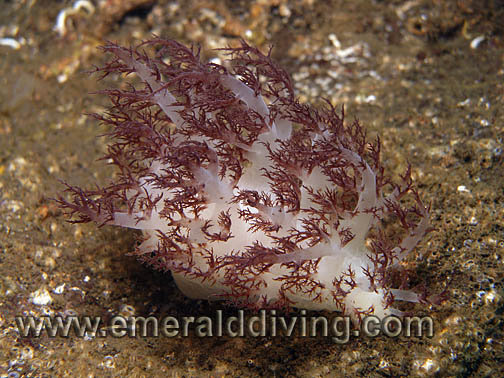
Red nudibranch, Dendronotus rufus
Conditions on this fall day could not be better. It was warm, the sun was out, and there was no wind. The day was a stinker current-wise, but the reef at KVI Tower has proven over the years to be somewhat immune to strong currents. Today was no exception.
I usually dive the west side of the reef as I find it more interesting. However, today I did my first dive on the east side of the reef. I found the old wooden boat wreck laying in about 90 feet of water. The wreck has decomposed tremendously since the last time I visited her a few years ago - only the stern section is recognizable. Situated at the base of the wreck was a mid-sized giant Pacific octopus. It sat motionless and looked about as startled as I was. It cautiously continued on its hunt for crabs and other goodies once it realized that I wasn't going to go away or harm it. It would envelop a rock with its shroud to trap its quarry, then filter our what it didn't want and keep the rest. I broke off pursuit of the eight-armed bandit when it continued down below 100 feet, which was my MOD on this dive. Vis underwater varied between 20 and 40 feet, but averaged close to 35. Very nice.
I ended this dive above the reef in an eelgrass bed taking in a colony of 30 or 40 nudibranchs which resembed shaggy-mouse nudibranchs (Aeolidia pappilosa), but didn't quite look right. Their cerata appeared longer and less dense, and their color was paler. Characteristic of Aeolidia pappilosa, these nudibranchs were busy devouring proliferating anemones attached to the eelgrass. Andy Lamb later confirmed these nudibranchs were Aeolidia pappilosa despite the different physical characteristics.
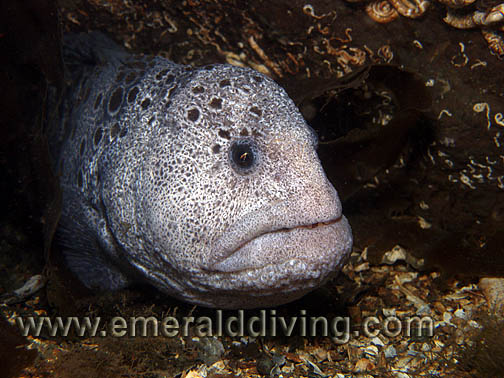
My second dive was on the west side of the reef. The second dive did not product any octopus sighting, but did yield two wolfeel sightings, including an open water encounter with a rather long, slender female wolfeel. I don't often find wolfeel at this site - in fact seeing two on one dive is a record for me. Three other noteworthy encounters included a red brotula (buried deep in a long, narrow lair), a red nudibranch (Dendronoutus rufus), and a lone vermilion rockfish. A resident vermilion rockfish used to patrol the western part of the reef, but I haven't seen it in over a year. I can't help but think this might be that fish. I did note that something has taken a bite out of the top end of its caudal fin, so it should be easy to identify on future excursions to this site. Noticeably absent was the small school of 4 yellowtail rockfish that I noted a couple of months ago when I dived here last. The presence of the yellowtail rockfish encouraged me to petition the WDFW to make this reef a rockfish no-take zone in hopes of helping the yellowtails recover in our area, but the request fell of deaf ears. On a more positive note, the population of black rockfish residing on this reef appears to be growing. I ended the dive getting more shots of shaggy-mouse nudibranch in the shallows.
Another (and the last) extraordinary day of diving brought to you and me by Super Puff.
I usually dive the west side of the reef as I find it more interesting. However, today I did my first dive on the east side of the reef. I found the old wooden boat wreck laying in about 90 feet of water. The wreck has decomposed tremendously since the last time I visited her a few years ago - only the stern section is recognizable. Situated at the base of the wreck was a mid-sized giant Pacific octopus. It sat motionless and looked about as startled as I was. It cautiously continued on its hunt for crabs and other goodies once it realized that I wasn't going to go away or harm it. It would envelop a rock with its shroud to trap its quarry, then filter our what it didn't want and keep the rest. I broke off pursuit of the eight-armed bandit when it continued down below 100 feet, which was my MOD on this dive. Vis underwater varied between 20 and 40 feet, but averaged close to 35. Very nice.
I ended this dive above the reef in an eelgrass bed taking in a colony of 30 or 40 nudibranchs which resembed shaggy-mouse nudibranchs (Aeolidia pappilosa), but didn't quite look right. Their cerata appeared longer and less dense, and their color was paler. Characteristic of Aeolidia pappilosa, these nudibranchs were busy devouring proliferating anemones attached to the eelgrass. Andy Lamb later confirmed these nudibranchs were Aeolidia pappilosa despite the different physical characteristics.
My second dive was on the west side of the reef. The second dive did not product any octopus sighting, but did yield two wolfeel sightings, including an open water encounter with a rather long, slender female wolfeel. I don't often find wolfeel at this site - in fact seeing two on one dive is a record for me. Three other noteworthy encounters included a red brotula (buried deep in a long, narrow lair), a red nudibranch (Dendronoutus rufus), and a lone vermilion rockfish. A resident vermilion rockfish used to patrol the western part of the reef, but I haven't seen it in over a year. I can't help but think this might be that fish. I did note that something has taken a bite out of the top end of its caudal fin, so it should be easy to identify on future excursions to this site. Noticeably absent was the small school of 4 yellowtail rockfish that I noted a couple of months ago when I dived here last. The presence of the yellowtail rockfish encouraged me to petition the WDFW to make this reef a rockfish no-take zone in hopes of helping the yellowtails recover in our area, but the request fell of deaf ears. On a more positive note, the population of black rockfish residing on this reef appears to be growing. I ended the dive getting more shots of shaggy-mouse nudibranch in the shallows.
Another (and the last) extraordinary day of diving brought to you and me by Super Puff.


Giant Pacific octopus hunting the reef at KVI Tower
Shaggy-mouse nudibranch, Aeolidia pappilosa
Female wolfeel, approximately 6' long.